
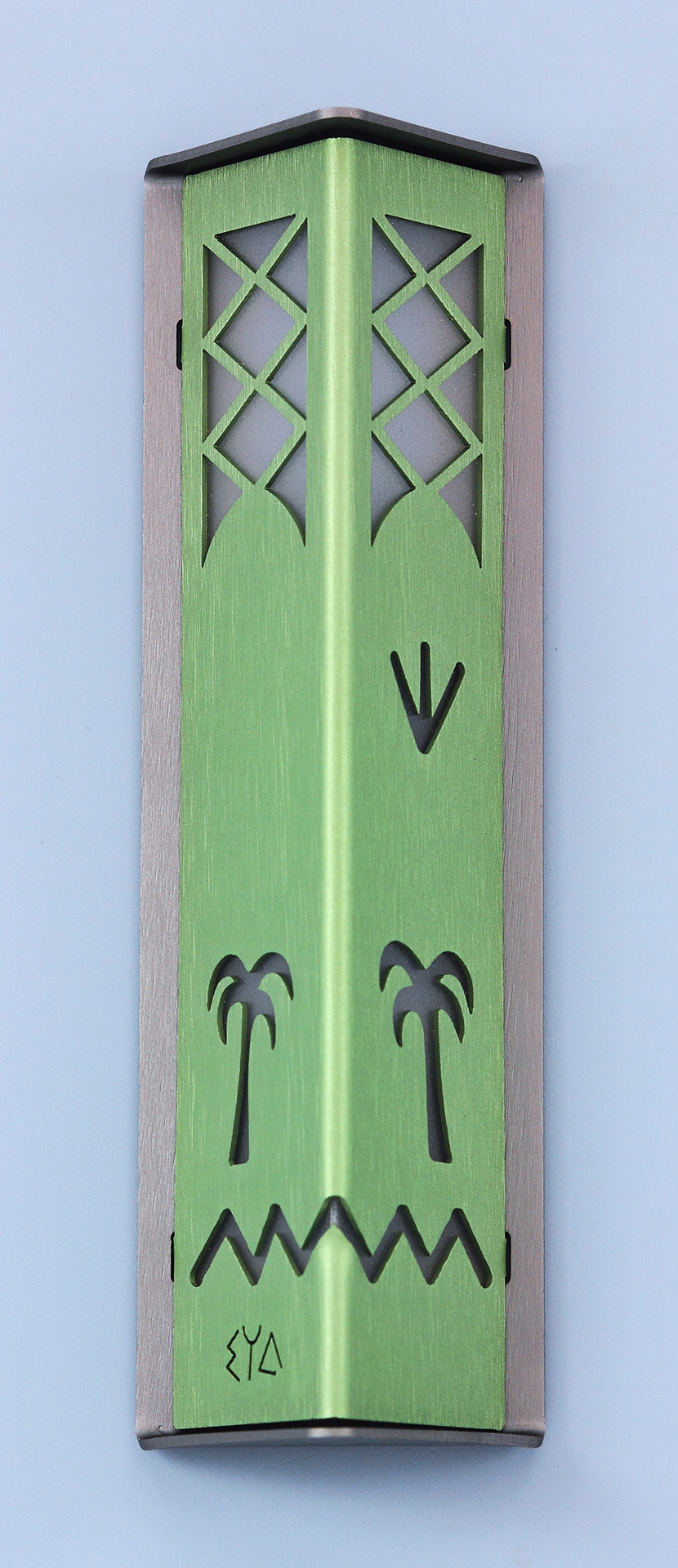
Mezuzah case – Date Palm
0.00₪
This anodized aluminum Mezuzah case features an elegant contemporary design
with a Date Palmmotif. Made from anodised aluminum in 3 different colors to
choose from.
Related products
-
 Click here to request a quoteMORE INFO
Birds Wall Hanging
0.00₪Birds wall hanging designed by the israeli artist Shraga Landesman.
‘Yea, the stork in the heaven knoweth her appointed times’; and the turtle and the crane and the swallow observe the time of their coming; but my people know not the judgment of the LORD. (Jeremiah 8, v7, King James Translation)
Each year in mid-February, the Common Swifts arrive in our area to nest. One of the nesting sites the swifts have chosen is the Western Wall. Swifts don’t nest in trees; they nest in cracks and crevices in buildings and walls. I find it moving to know that the migration pattern of these birds was observed thousands of years ago, and that when Jeremiah used this metaphor as he tried to return the People of Israel to their path, he might even have been looking at the Western Wall. -
Click here to request a quoteMORE INFO
Ana Be’koah Wall Hanging
0.00₪Ana be’koah wall hanging designed by the israeli artist Shraga Landesman.
Ana B’koach [We beg thee with the strength (and greatness of thy right arm.)]
This liturgical poem is part of the morning prayers . It was written in the Middle Ages by Rabbi Nehunia ben Hakaneh. The poem is composed of seven lines with six words each. The initial letters of each word can be combined to make a name of 42 letters. According to Kabbalah, this is one of the names of G_d.
Ari-Hakadosh (Yitzhak Ben Shlomo Ashkenazi) of Tzfat wrote in his book that without this prayer, a person cannot advance to the next spiritual level. This is why the prayer should be said each morning. According to The Zohar, the words of “Ana B’koach” are the wings of angels, helping us to advance to the next level.Made with brass.
Size : 95 mm. in diameter.
-
Click here to request a quoteMORE INFO
Hamsa Ben Porat Josef Wall Hanging
0.00₪Hamsa ben porat Josef wall hanging designed by the israeli artist Shraga Landesman
“Joseph is a fruitful bough, even a fruitful bough by a well; whose branches run over the wall”(Genesis 49:22, King James Version)
This is the blessing Jacob gives to Joseph before his death. We find this verse written on amulets from the first century, and with good reason. In Talmudic times, Talmudic sages taught that Joseph and his descendants were protected against the Evil Eye; that is, the Evil Eye has no power over them. The Talmud compares Joseph’s descendants to fish in the sea—the water covers them, so the Evil Eye can’t control them. So it is for Joseph’s descendants, too: the Evil Eye can’t control them. -
Click here to request a quoteMORE INFO
Zaharti Leha Wall Hanging
0.00₪‘Jeremiah’s prophecy’ wall hanging designed by the israeli artist Shraga Landesman.
I remember thee, the kindness of thy youth (Jeremiah 2:2, King James)
In Jeremiah’s first prophecy, I love the metaphor the prophet uses to describe the deepening relationship between the partners who are living on memories of shared experiences from the past.
The spiral in this work describes the 40 years of wandering in the desert as a time of bonding, and the 12 palm trees represent the 12 tribes.


