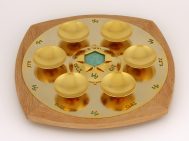

Pomegranate Honey Cup
0.00₪
This honey dish, product of Judaica artist ,Shraga Landesman, is Made from anodised aluminum, and it is shaped like a pomegranate with a matching bowl. This serving item suitable for any holiday or festive event!
Related products
-
 Click here to request a quoteMORE INFO
Pomegranate from Aleph to Taf (A to Z)
0.00₪Pomegranate from aleph to taf (A to Z)
It is said that the Torah is as full as a pomegranate. Why did the sages choose the pomegranate? Because in most types of fruit, there’s a small space full of air. The Torah, like the pomegranate, is so full of seeds there’s not even a drop of air.
To illustrate this saying, I chose to fill the pomegranate with all the letters, from aleph to taf, which are used to write the Torah. -
Click here to request a quoteMORE INFO
Spring Seder Plate
0.00₪Passover is also called the festival of spring, evidence of which can be found in the Book of Exodus in the verse that adorns this Passover plate “Today you go out in the month of spring” [Exodus 13.4].
This Passover plate is made of gold plated brass placed on an oak tree. -
Click here to request a quoteMORE INFO
Hamsa Ben Porat Josef Wall Hanging
0.00₪Hamsa ben porat Josef wall hanging designed by the israeli artist Shraga Landesman
“Joseph is a fruitful bough, even a fruitful bough by a well; whose branches run over the wall”(Genesis 49:22, King James Version)
This is the blessing Jacob gives to Joseph before his death. We find this verse written on amulets from the first century, and with good reason. In Talmudic times, Talmudic sages taught that Joseph and his descendants were protected against the Evil Eye; that is, the Evil Eye has no power over them. The Talmud compares Joseph’s descendants to fish in the sea—the water covers them, so the Evil Eye can’t control them. So it is for Joseph’s descendants, too: the Evil Eye can’t control them. -
Click here to request a quoteMORE INFO
Pomegranate Paper Weight
0.00₪The pomegranate is one of the seven species in which the Land of
Israel is blessed.
The pomegranate ripens at the beginning of the autumn and
symbolizes abundance, fertility, beauty and wisdom.
According to Maimonides, the pomegranate has many medicinal
properties.