
- View cart You cannot add another "Menorah Wall Hanging" to your cart.
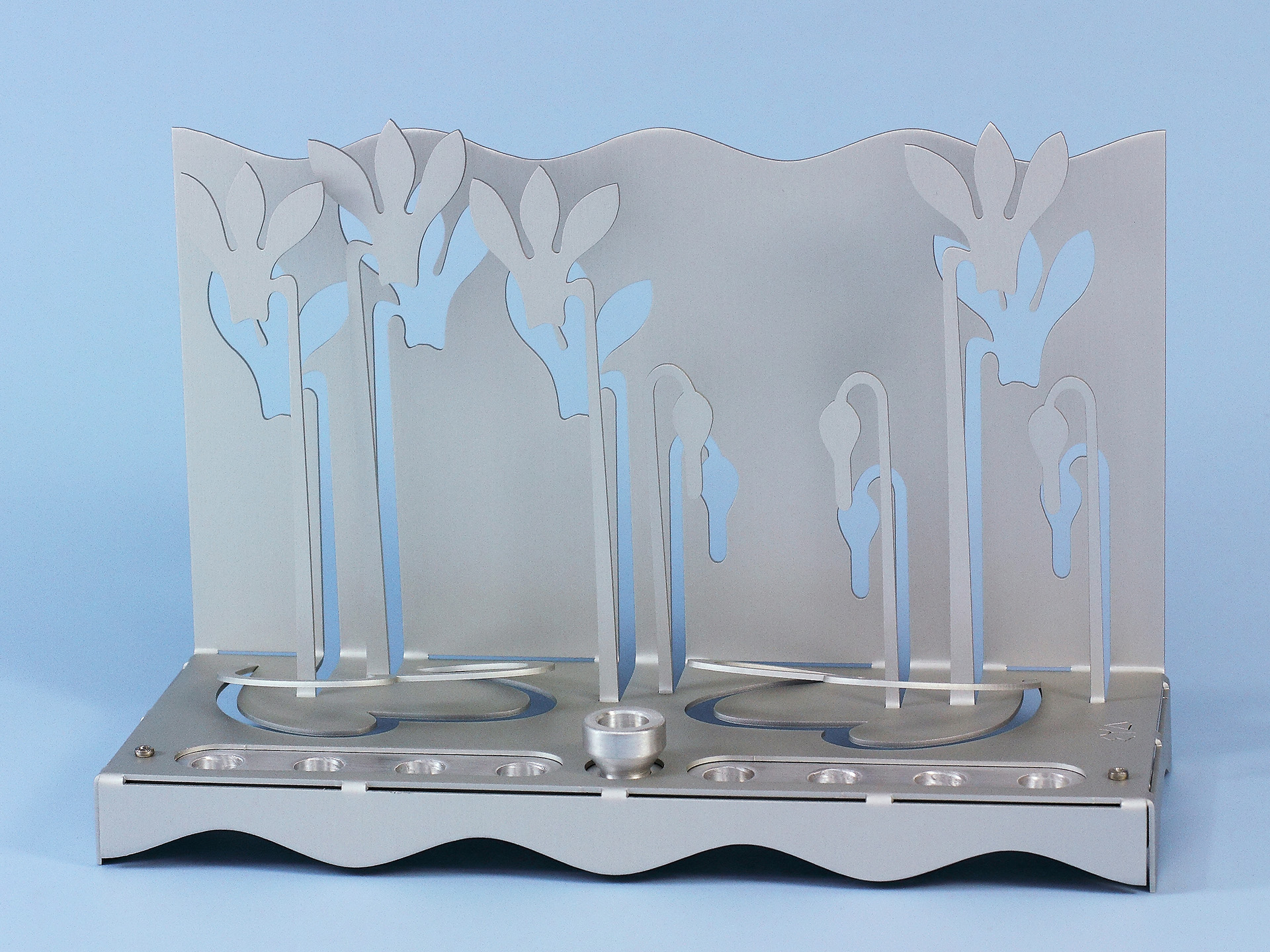

Cyclamens Menorah
0.00₪
Every winter the cyclamen wake up and fill the
forest like candles that illuminate the gray winter
Related products
-
 Click here to request a quoteMORE INFO
Hamsa Ben Porat Josef
0.00₪“Joseph is a fruitful bough, even a fruitful bough by a well; whose branches run over the wall”(Genesis 49:22, King James Version)
This is the blessing Jacob gives to Joseph before his death. We find this verse written on amulets from the first century, and with good reason. In Talmudic times, Talmudic sages taught that Joseph and his descendants were protected against the Evil Eye; that is, the Evil Eye has no power over them. The Talmud compares Joseph’s descendants to fish in the sea—the water covers them, so the Evil Eye can’t control them. So it is for Joseph’s descendants, too: the Evil Eye can’t control them. -
 Click here to request a quoteMORE INFO
Menorah Wall Hanging
0.00₪Menorah wall hanging designed by the israeli artist Shraga Landesman.
I [am] my beloved’s, and my beloved [is] mine (Song of Songs 6:3, King James Version)
This verse from the Song of Songs expresses the two-way relationship between the People of Israel and their G_d. The sages saw a clue in the initials of these words to the month of Elul. Each year during the month of Elul, we prepare ourselves for the renewal of this closeness through soul-searching. -
 Click here to request a quoteMORE INFO
Pomegranate Paper Weight
0.00₪The pomegranate is one of the seven species in which the Land of
Israel is blessed.
The pomegranate ripens at the beginning of the autumn and
symbolizes abundance, fertility, beauty and wisdom.
According to Maimonides, the pomegranate has many medicinal
properties. -
 Click here to request a quoteMORE INFO
Wall Hanging
0.00₪A designed wall hanging by the israeli artist Shraga Landesman.
The main design and the story of this necklace comes by a quote from the bible (“Cast thy bread upon the waters”) in a circle pendant that hang on body by a silver chain.
“Cast thy bread upon the waters” (Ecclesiastes 11:1, King James);
This is the advice of Kohelet (Ecclesiastes). We can interpret this advice literally, as throwing bread on the surface of the water so the fish become accustomed to approaching the shore. Then we can catch them.
However, most interpretations teach us that Kohelet is advising us to do good deeds for others, without expecting anything in return.