- View cart You cannot add another "Wall Hanging" to your cart.

Log and Flower Candleholder
0.00₪
Featuring a charming double flower design resting in a hollow log, this candlestick
set is perfect for adding elegance to your family’s Shabbat table. Dimensions:
26×7.5×7.5
Related products
-
 Click here to request a quoteMORE INFO
Wall Hanging
0.00₪You are beautiful wall hanging designed by the israeli artist Shraga Landesman.
The main design and the story of this necklace comes in a circle padent that hang on body by a silver chain.Behold, thou [art] fair, my love; behold, thou [art] fair; thou [hast] doves’ eyes. (Song of Songs, 1:15, King James Version)
This verse from the Song of Songs is a metaphor describing the love between two people. According to tradition, the sages say the Song of Songs is an allegory representing the relationship between the People of Israel and their God.
We read the Song of Songs on the Shabbat of Passover, since it describes many images of spring. -
 Click here to request a quoteMORE INFO
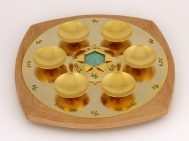
Spring Seder Plate
0.00₪Passover is also called the festival of spring, evidence of which can be found in the Book of Exodus in the verse that adorns this Passover plate “Today you go out in the month of spring” [Exodus 13.4].
This Passover plate is made of gold plated brass placed on an oak tree. -
 Click here to request a quoteMORE INFO
Pomegranate Wall Hanging
0.00₪Pomegranate wall hanging designed by the israeli artist Shraga Landesman.
Pomegranate from aleph to taf (A to Z)
It is said that the Torah is as full as a pomegranate. Why did the sages choose the pomegranate? Because in most types of fruit, there’s a small space full of air. The Torah, like the pomegranate, is so full of seeds there’s not even a drop of air.
To illustrate this saying, I chose to fill the pomegranate with all the letters, from aleph to taf, which are used to write the Torah. -
 Click here to request a quoteMORE INFO
Ana be’koah
0.00₪Ana be’koah framed designed by the israeli artist Shraga Landesman.
Ana B’koach [We beg thee with the strength (and greatness of thy right arm.)]
This liturgical poem is part of the morning prayers . It was written in the Middle Ages by Rabbi Nehunia ben Hakaneh. The poem is composed of seven lines with six words each. The initial letters of each word can be combined to make a name of 42 letters. According to Kabbalah, this is one of the names of G_d.
Ari-Hakadosh (Yitzhak Ben Shlomo Ashkenazi) of Tzfat wrote in his book that without this prayer, a person cannot advance to the next spiritual level. This is why the prayer should be said each morning. According to The Zohar, the words of “Ana B’koach” are the wings of angels, helping us to advance to the next level.